Driving Test Edmonton: A Complete Guide to Passing on Your First Try
Booking a Driving Test Edmonton applicants can pass confidently starts with understanding exactly what examiners look for and how Alberta’s Graduated Driver Licensing (GDL) system works. At Alberta Driving School, we’ve guided thousands of new drivers through the road test process, and the pattern is consistent: preparation, not luck, determines who passes on the first attempt. This guide walks through what to expect, how to prepare, and the mistakes that cost new drivers their license on test day.
Whether you’re a teenager working through the GDL stages or a newcomer to Canada converting a foreign license, this guide applies the same core principles that shape every successful road test outcome.
Understanding the Driving Test Edmonton Process
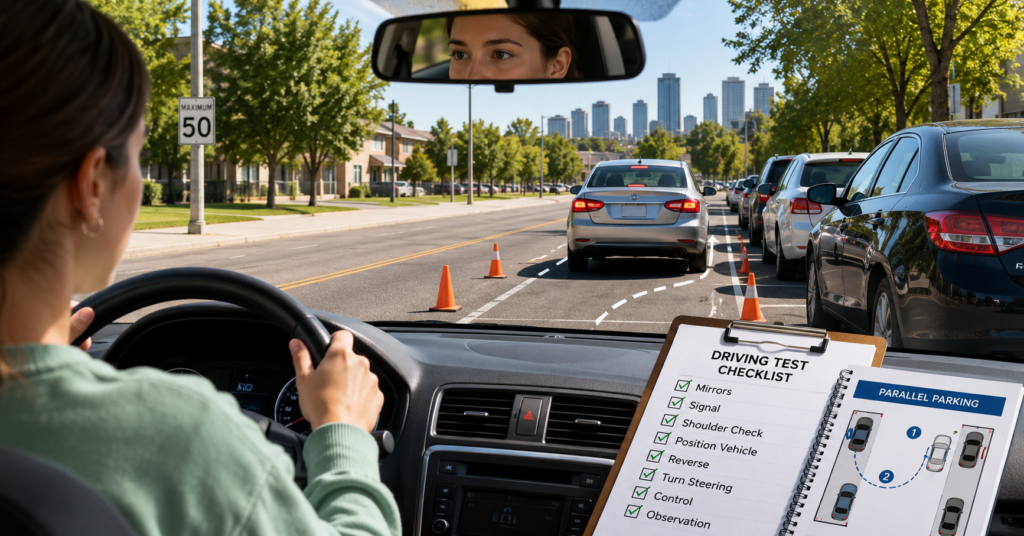
Alberta’s road test evaluates more than whether you can operate a vehicle. Examiners are assessing decision-making under real traffic conditions, which is why a driving test Edmonton route typically includes:
- Residential streets with parking maneuvers
- Multi-lane roads requiring lane changes and merges
- Intersections with varying signage (stop signs, yield signs, traffic lights)
- At least one instance of parallel parking or a three-point turn
- Highway or higher-speed road sections, depending on license class
Each of these elements tests a specific skill category, and examiners score against a standardized checklist rather than subjective impressions.
Class 5 vs. Class 7 Road Tests
Alberta’s GDL system separates learners into stages:
- Class 7 (Learner) — requires a written knowledge test, not a road test, but sets the foundation for later stages.
- Class 5 GDL (Probationary) — the first road test, focused on fundamentals: signaling, shoulder checks, speed control, and basic maneuvers.
- Class 5 (Full) — the advanced road test, typically taken after two years on probationary status, covering higher-speed and more complex driving scenarios.
Register Now
Knowing which class you’re testing for changes how you should prepare, since the advanced test weighs highway merging and complex intersections more heavily.
Benefits of Structured Drivers Training Edmonton Programs
Self-taught drivers can pass the driving test Edmonton examiners administer, but structured drivers training Edmonton programs consistently produce stronger first-attempt pass rates. Here’s why:
- Standardized curriculum — instructors cover every skill examiners test, not just the ones a parent or friend remembers to practice.
- Real-time correction — a licensed instructor catches bad habits (rolling stops, late shoulder checks) before they become ingrained.
- Mock test familiarity — many Edmonton driving school programs run practice routes that mirror actual test conditions.
- Reduced test-day anxiety — students who’ve trained with a professional instructor report feeling calmer, which directly improves performance under evaluation.
Pros and Cons: Professional Training vs. Self-Practice
| Factor | Structured Driving School | Self-Practice Only |
|---|---|---|
| Skill consistency | High — standardized checklist | Variable, depends on who’s teaching |
| Bad habit correction | Immediate, professional feedback | Often missed |
| Cost | Higher upfront investment | Lower direct cost |
| Insurance discounts | Frequently eligible | Rarely eligible |
| First-attempt pass rate | Generally higher | Generally lower |
How to Prepare for Your Driving Test Edmonton Appointment
Follow these steps in the weeks leading up to your test:
- Book early. Road test appointments in Edmonton often have multi-week waitlists, especially in spring and summer. Book as soon as you’re eligible.
- Practice on test-adjacent routes. Registries often test near their office locations. Practicing similar road types builds familiarity with local signage and traffic patterns.
- Master the pre-drive vehicle check. Examiners commonly ask about mirrors, seatbelt, and basic vehicle knowledge before the drive even starts.
- Drill shoulder checks until they’re automatic. Missed shoulder checks are one of the most common reasons for point deductions.
- Practice parking maneuvers repeatedly. Parallel parking and three-point turns cause more test failures than any other single skill.
- Do a mock test the week before. A trial run with an instructor mimics real test pressure and surfaces last-minute weak points.
Common Mistakes That Fail Drivers on Test Day
- Rolling through stop signs instead of coming to a complete stop.
- Forgetting to check blind spots before lane changes.
- Driving too far below the speed limit, which can also count against you.
- Poor space management when following other vehicles.
- Hesitating too long at intersections, signaling indecision to the examiner.
Read More:- How to Find the Best Driving School in Edmonton: A Complete Guide for New Drivers
Expert Insight: What Instructors Notice Most
Certified instructors who’ve spent years administering mock tests before actual road tests point to one recurring issue: nervous drivers over-correct. A driver who’s confident but makes a minor error often scores better than a driver who’s technically skilled but freezes at an intersection. This is why structured drivers training Edmonton programs spend as much time on test-day composure as they do on technical skill — confidence under evaluation is a trainable habit, not a personality trait.
A useful example: a new driver who consistently rolled through stop signs during solo practice corrected the habit within two lessons once an instructor pointed out the specific moment — three car lengths before the sign — where braking needed to begin. Small, specific corrections like this tend to fix problems that months of unguided practice never catch.
Choosing the Right Edmonton Driving School
Not all programs offer the same value. When comparing an Edmonton driving school, look for:
- Certified instructors registered with Alberta’s driver training standards.
- Dual-brake vehicles for in-car safety during lessons.
- Flexible scheduling that accommodates school or work hours.
- Transparent pricing with no hidden fees for mock tests or extra sessions.
- Positive, recent reviews focused specifically on road test preparation, not just general driving lessons.
A strong Edmonton driving school will also track your progress across sessions, adjusting lesson plans based on which skills need more repetition rather than running a generic, one-size-fits-all curriculum.
Passing your driving test Edmonton appointment comes down to structured preparation, not last-minute cramming. Understanding the GDL stages, practicing the specific maneuvers examiners test, and training with a certified Edmonton driving school all stack the odds in your favor. Whether you choose full drivers training Edmonton programs or supplement self-practice with a few professional lessons, the drivers who pass on the first attempt are consistently the ones who prepared deliberately rather than hoping for the best on test day.
Frequently Asked Questions
How do I book a driving test Edmonton appointment?
Road tests are booked through Alberta Registries, either online or in person at a registry office. Booking early is recommended, since wait times can extend several weeks during peak seasons.
What’s the difference between Class 5 GDL and Class 5 full road tests?
The Class 5 GDL test evaluates basic driving fundamentals for probationary drivers, while the Class 5 full test, taken after two years, covers more advanced scenarios like highway driving and complex intersections.
How many hours of drivers training Edmonton programs typically recommend?
Most structured programs recommend a minimum of 10–15 hours of professional instruction, though total hours needed vary based on the driver’s existing experience and comfort level.
What are the most common reasons drivers fail their road test?
Rolling stops, missed shoulder checks, poor parking maneuvers, and hesitation at intersections are among the most frequent reasons for test failure.
Is professional training required to pass the driving test in Edmonton?
No, professional training isn’t mandatory for most license classes, but structured instruction generally improves first-attempt pass rates by targeting the specific skills examiners assess.